Jump to the researched divided-glass example →
The primary question: does the meal have a stable ratio?
A divided container works best when the meal pattern repeats. Think chicken and vegetables, curry and rice, or a larger main with a smaller side. If the ratio changes every week, a fixed divider can leave one side overfilled and the other nearly empty. The right decision begins with the meals, not the appearance of the tray.
Write down five meals you expect to freeze. If at least three naturally use the same main-to-side relationship, a divided format may reduce packing decisions. If most meals are soups, casseroles, pasta bakes or mixed bowls, one open cavity usually offers more flexibility.
Where two compartments add real value
Texture separation
Keep a dry or crisp side away from a saucier main until the meal is ready.
Repeatable portions
Use one larger well for the main and one smaller well for a regular side.
One-package lunch
Carry and label the complete meal as a single unit instead of two containers.
Visual planning
See whether the meal contains both planned components before it enters the freezer.
Where a divider creates friction
Dividers reduce the continuous volume available to bulky food. A chicken breast, burrito, lasagna square or irregular roast portion may fit poorly even when the listed total capacity looks generous. The divider also affects stirring and rearranging during microwave reheating. Thick foods in the larger well and a dense side in the smaller well may heat at different rates.
Liquids need special attention. A divided base is not automatically leakproof between compartments, and the exterior lid claim does not prove that sauce will remain in one well when the container is tilted. Use the format for foods and orientations supported by the exact product instructions.
Use capacity by compartment, not total capacity
A 5.8-cup divided container is not one 5.8-cup open space. The Pyrex example below lists a 3.3-cup larger section and a 2.2-cup smaller section. That ratio is the useful specification. Compare each well with the amount of food it must hold after leaving suitable headroom.
External dimensions still matter. Divided glass containers are often broad and relatively shallow. That can support complete meals and reheating, but it may use more shelf width than a taller single-cavity box. Measure the exact freezer lane and test how many complete containers can be removed without rebuilding the stack.
A current two-compartment glass example
Pyrex MealBox is useful here because the manufacturer publishes the capacity of each compartment. The example is not a universal recommendation for every meal. It is a way to test whether a 3.3-cup main and a 2.2-cup side match the household's recurring menu.
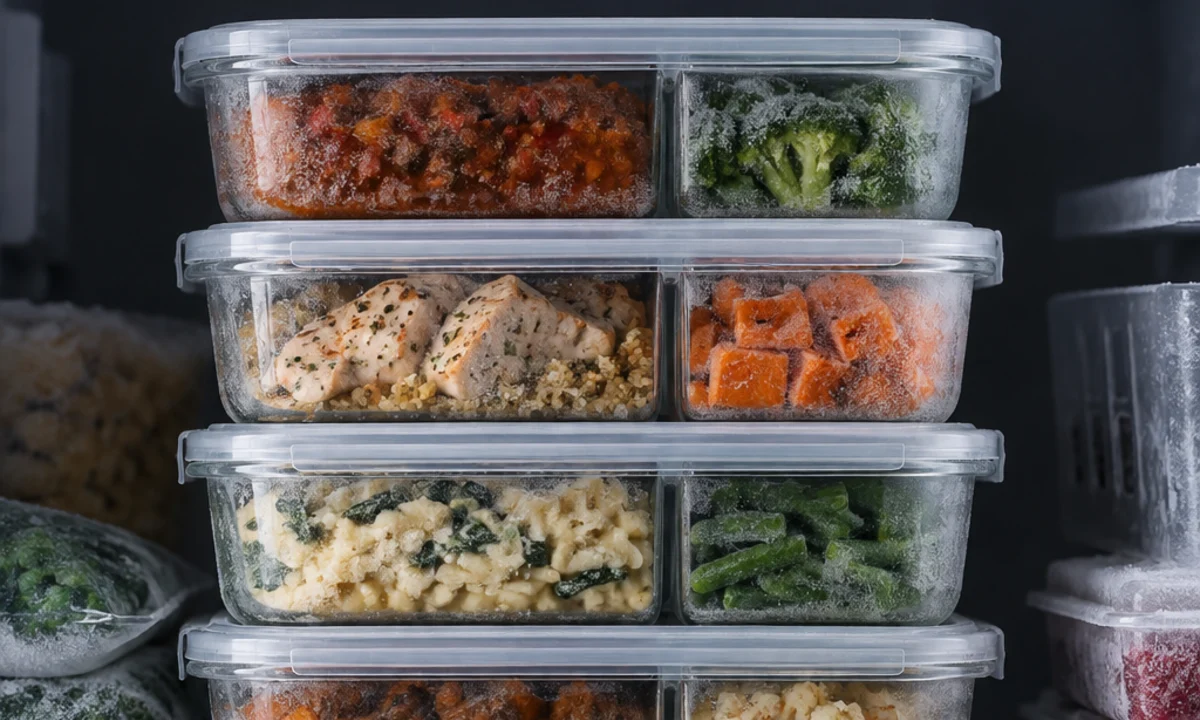
Pyrex MealBox Divided Glass
Why it made the shortlistConsider when a larger main and smaller side repeatedly fit the menu, and the broad 5.8-cup glass footprint fits the measured freezer lane.
- Useful for
- Complete meals that benefit from one larger main compartment and one smaller side compartment.
- Source-checked details
- Pyrex specifies a 5.8-cup divided glass container with a 3.3-cup main section and a 2.2-cup side section. The manufacturer lists the container and lid as freezer and microwave safe, with dishwasher care directions for both parts.
- Watch for
- The fixed two-compartment ratio suits some meals and constrains others. The manufacturer page for the single container was unavailable at the evidence check, while the Amazon five-pack listing was available; confirm the live model and lid directions.
Check the exact model, seller, availability and current terms on the live listing before buying.
Image note: This generic, unbranded image illustrates the product type and is not a photograph of the exact named product.
A five-meal fit test
- List five real meals. Include the food and approximate quantity in each compartment.
- Mark foods that should touch. Mixed bowls and casseroles may gain nothing from a divider.
- Mark foods that should stay apart. Texture, sauce and personal preference can make separation useful.
- Check the reheating sequence. Decide whether both sides can reheat together or one needs to be removed or added later.
- Count successful matches. If the layout fits only one occasional meal, a flexible one-cavity container may deserve the shelf space more.
Common mistakes
- Comparing only total capacity and ignoring the capacity of each well.
- Assuming the internal divider prevents sauce migration in every orientation.
- Buying a five-pack before confirming that five recurring meals fit the same ratio.
- Using the lid during reheating without checking the exact microwave directions.
- Choosing compartments for portion-control aesthetics when the household prefers mixed meals.
Useful detail
Questions behind the divider
A fixed compartment is useful only when its ratio, depth and reheating behavior match meals the household already makes.
How do you test a compartment ratio before buying?
Measure the main and side from several real meals, then compare each amount with the capacity of the corresponding well. Include expansion and stirring room. The total container capacity cannot show whether either individual compartment will fit.
Does an internal divider prove that sauces stay separate?
No. The height and seal of the internal divider vary, and the outer lid claim does not establish separation between wells. Use only the orientation and food types supported by the exact product instructions.
When is one open cavity more useful?
Choose an open cavity when portions change, food is bulky, the meal is mixed or stirring matters during reheating. A divider should solve a repeated separation problem, not create a fixed shape that the menu must work around.
Compare capacity and shape without a dividerCompare the alternative
Need flexible portions instead of fixed compartments?
Return to the glass-system guide to compare repeated one-cavity containers with mixed-size sets.
Compare glass container systems →